Wasser hoferLand.digital Transfer Workshop
The Water Transfer Workshop connects applied research, digital innovation, and municipal action into a laboratory space
Funding Programme
Hof District
Background
The Water Transfer Workshop hoferLand.digital is a subproject of the Hof District's Smart City pilot project, which specifically uses digital technologies as tools to make water-related challenges posed by climate change manageable at the regional level and to sustainably improve living conditions for the population. Anchored in Theme Area C, "Digital H2O Management," of hoferLand.digital, the subproject is aimed at all 27 municipalities in the district and serves as a bridge between research, municipal practice, and digitally supported climate adaptation.
Objectives
Package of Measures 1: Analysis of tasks and circumstances in the local authorities
The central methodological framework is the multi-level analysis developed by Hof University of Applied Sciences, which is used in workshops in each of the 27 local authorities to identify the current range of tasks, existing plans, ‘inherent potential’ and possible ‘sponge’ measures. The results are digitised, evaluated using a web-based analysis tool and jointly prioritised; based on this, suitable action plans and implementation concepts are drawn up. A meta-analysis is carried out for all 27 local authorities to identify interfaces, synergies and cross-cutting potential for action, with a view to identifying and implementing joint projects.
Package of Measures 2: Specific Implementation Projects
The digital consolidation of drinking water demand and water supply data from all local authorities on a central data platform is intended to provide, for the first time, a county-wide overview of availability, usage and bottlenecks—a vital basis for decision-making in the face of increasing periods of drought, falling groundwater levels and rising consumption. The platform integrates local measurement data and publicly available datasets, and enables analyses and forecasts for potential critical situations.
The issue of extraneous water
Groundwater, spring water and surface water that enters sewage systems via leaks causes false loads, costs and efficiency losses in wastewater treatment plants. The project systematically compiles existing studies, supplements missing analyses, consolidates the results within a common data structure and derives comparable remediation and optimisation strategies to achieve synergies, cost savings and accelerated implementation.Digital mapping of water-related soil parameters
Water-related soil parameters are being digitally mapped in selected forest areas. This is intended to strengthen climate-resilient agricultural and forestry management. Local sensor networks, remote sensing via drones and satellites, and laboratory analyses are combined to enable spatially differentiated monitoring of the water balance in future and to plan measures—ranging from irrigation control to targeted infiltration for flood mitigation—in a data-driven manner. The ‘BodenRadar’ system, co-developed at inwa, is being adapted for this purpose, linked to IoT sensors and tested in the field.Solution database for the Hofer Land Sponge Region
With a view to the transformation into the Hofer Land Sponge Region, a district-wide solution database is being created which systematically records technical, nature-based and organisational sponge measures, provides guidance on evaluation and is intended to serve local authorities as a planning and learning resource. The aim is to create a robust database that feeds into analyses and highlights concrete implementation pathways.Virtual operational assistant for water management facilities
The complexity of water management infrastructure and scarce staffing resources call for intelligent assistance: An AI-based support bot, utilising the open-source LLM ‘Lisa’ developed by Hof University of Applied Sciences, is designed to support operational staff and planners with fault-finding, maintenance decisions, document access, training and career transitions. Generative AI enables faster fault diagnosis, the provision of context-specific knowledge, the optimisation of maintenance cycles and the personalisation of learning processes.Advisory Service at the Competence and Transfer Centre for Sustainable Sponge Cities and Regions (ktns)
To ensure the continued development of knowledge, an advisory and contact point specifically for the 27 local authorities is being set up at the Centre of Excellence and Transfer for Sustainable Sponge Cities and Regions (ktns) at the Institute for Sustainable Water Systems at Hof University of Applied Sciences. In addition to further training opportunities, the services on offer include, amongst other things, coaching throughout projects, specialist advisory support prior to the start of planning (known as ‘Phase 0’) and assistance with securing funding.
Contents
A structured transfer of the results beyond the district is part of the funding mandate: all analyses, tools, data structures and recommendations for action are assessed for their transferability, compared with existing guidelines on sponge city planning and training curricula (including 'The Path to a Sponge City' and 'Specialist Engineer in Digitalisation of Water Management'), and documented.
The Water Transfer Workshop combines applied research, digital innovation and local government action to create a laboratory environment in which data-driven climate adaptation is scientifically evaluated and water-related issues are tested in practice and embedded within the regional context.
Addressed SDGs (Sustainable Development Goals)
Contact Persons
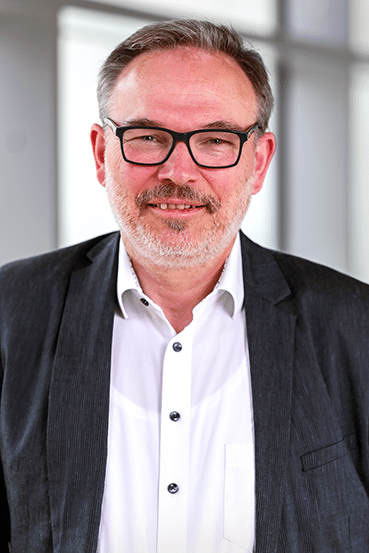
Prof. Günter Müller-Czygan
Head of Research Group


Michael Schmidt
Research Associate
Projects
More Research Projects

Decision Support System for Sponge-like Corridors
Active
Feasibility study for the development of a decision support system for analyzing the impact of measures for runoff-slowing and water-retaining landscape design
To the Project
Reform of industrial wastewater treatment in Saudi Arabia through demonstration of a3op® technology
Active
To the Project
BIK3I
Active
Condition-based maintenance of small-scale sewage treatment plants using IoT and AI
To the Project


ReKorD
Active
Realization of a supra-regional circular economy through fertilizer development
To the Project

DRhN-Booster
Completed
Digital Recruiting for Sustainability – AI-supported educational module
To the Project


TIMEA
Completed
Accelerating the transfer of innovations through web-based multi-level analysis
To the Project
Sponge Balcony
Completed
Sponge Balcony – concept development for innovative evaporation production
To the Project
digi-Sponge (Certificate Course)
Completed
Certificate course on digital methods in sponge city projects
To the Project
Rotary Arc 4.0
Completed
Dynamic sewer network management with obstacle-free control element
To the Project

IntelliFluQs
Completed
Intelligent flow and quality control for the fourth treatment stage
To the Project
ITTQ-Wasser
Completed
Engineering-technical transfer qualification for Bavarian water management
To the Project


pharmIn2
Completed
Efficient treatment of wastewater from the pharmaceutical industry in India
To the Project

InSchuKa4.0
Completed
Combined infrastructure and environmental protection through AI-based sewer network management
To the Project