
ReKorD
Realization of a supra-regional circular economy through fertilizer development
Funding Programme
Europäischer Fonds für regionale Entwicklung Operationelles Programm im Ziel „Investitionen in Beschäftigung und Wachstum“ Bayern 2021- 2027

Background
An innovative aspect of the project is the newly developed organo-mineral fertilisers and the associated production technology, which are regarded as key criteria. These innovations promise significant improvements across the entire food production sector, which depends directly or indirectly on plant fertilisation. Furthermore, changes will occur in the upstream sector of the fertiliser industry and fertiliser trade, as well as in the downstream sector of waste utilisation.
A pioneering aspect is the high degree of globalisation of value chains in primary agricultural production. The project therefore aims to establish decentralised nutrient recycling in nutrient-rich regions, with the objective of transferring nutrients to areas in need of them. This significantly strengthens agriculture within the single market and increases the potential for value creation for farmers. By improving these structures, the project can indirectly counteract the decline in farm numbers and promote more sustainable agriculture.
Objectives
The project aims to close supra-regional nutrient cycles more efficiently through the use of organic manure from livestock farming and crop production. In Bavaria, there are significant differences between regions with large livestock populations and surpluses of organic manure, and arable farming regions that require mineral fertilisers.
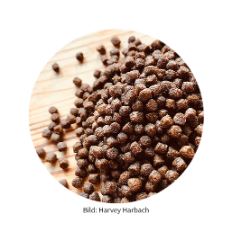
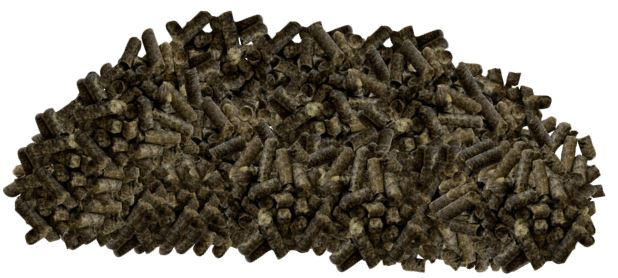
The aim is to bind livestock manure into pellets with added ingredients and to preserve them long-term without the use of drying energy. Using innovative technology, natural components are being developed into a moisture-stable granulate designed to improve the soil quality of arable land. In addition, a methodology for measuring nutrient content is being developed, which will enable the fertiliser to be scaled up and strengthen regional value creation. The project promotes the sustainable use of waste materials and supports the independence of the German domestic market.
Contents
Environmentally friendly and resource-efficient technologies: The innovative pelletising machines for industrial wool scraps enable the production of functionally enhanced fertiliser pellets, which can adsorb further nutrients from slurry and are easy to transport once air-dried. This promotes decarbonisation, as less nitrogen fertiliser is required – a product manufactured using fossil fuels via the energy-intensive Haber-Bosch process. Furthermore, there is an overall reduction in the need to transport fertiliser and raw materials from third countries. This simultaneously represents a biotechnological solution for climate protection and energy. Overall, this enables continuous nutrient recycling, which contributes to the circular economy, thereby conserving resources.
Project Partners
Institute of Materials Science, Hof University of Applied Sciences
Addressed SDGs (Sustainable Development Goals)
Contact Persons
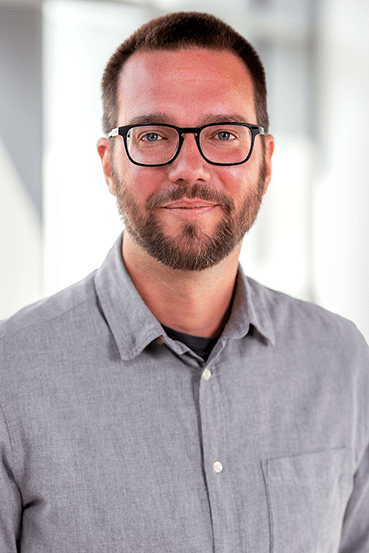
Dr. Harvey Harbach
Research Group Leader


Projects
More Research Projects

Decision Support System for Sponge-like Corridors
Active
Feasibility study for the development of a decision support system for analyzing the impact of measures for runoff-slowing and water-retaining landscape design
To the Project
Reform of industrial wastewater treatment in Saudi Arabia through demonstration of a3op® technology
Active
To the Project
BIK3I
Active
Condition-based maintenance of small-scale sewage treatment plants using IoT and AI
To the Project

Wasser hoferLand.digital Transfer Workshop
Active
The Water Transfer Workshop connects applied research, digital innovation, and municipal action into a laboratory space
To the Project


DRhN-Booster
Completed
Digital Recruiting for Sustainability – AI-supported educational module
To the Project

TIMEA
Completed
Accelerating the transfer of innovations through web-based multi-level analysis
To the Project
Sponge Balcony
Completed
Sponge Balcony – concept development for innovative evaporation production
To the Project
digi-Sponge (Certificate Course)
Completed
Certificate course on digital methods in sponge city projects
To the Project
Rotary Arc 4.0
Completed
Dynamic sewer network management with obstacle-free control element
To the Project

IntelliFluQs
Completed
Intelligent flow and quality control for the fourth treatment stage
To the Project
ITTQ-Wasser
Completed
Engineering-technical transfer qualification for Bavarian water management
To the Project


pharmIn2
Completed
Efficient treatment of wastewater from the pharmaceutical industry in India
To the Project

InSchuKa4.0
Completed
Combined infrastructure and environmental protection through AI-based sewer network management
To the Project