
FRAU-PAZ
Strategies for ecological peace promotion

Funding Programme
Das Abkommen über den Transfer von Finanzmitteln wird von DAAD durch die Justus-Liebig-Universität Gießen - Professur für Internationale Beziehungen und Friedensforschung zugleich Gründungsprofessur für das Deutsch-Kolumbianische Friedensinstitut CAPAZ - finanziert
Background
Since the 2016 peace agreement, Colombia has faced the major challenge of finding a lasting s olution to its long-standing armed conflicts. The Magdalena Medio region – an area rich in biodiversity and home to vital water and forest resources – has been particularly affected. Despite its central importance for biodiversity and climate protection, the region continues to suffer from structural violence, social inequality and massive environmental destruction.
In the context of the Colombian peace process, women in particular – for example through the Organización Femenina Popular (OFP) – have developed innovative approaches to peace that integrally link ecological sustainability, collective memory and social structures. From a gender-specific perspective, they make a significant contribution to strengthening social cohesion and protecting territorial resources. The long-term preservation of these ecosystems is proving to be key to a just and sustainable peace.
Objectives
GENERAL OBJECTIVE:
To examine environment-related peace strategies employed by women's communities in Magdalena Medio, based on a concept of the 'feminine' – with particular attention to the role of the Organización Femenina Popular.
Specific objectives:
To analyse the concept of 'femininity' within the context of the development of the Organización Femenina Popular – with a particular focus on the territorial perspective and its ecological dimensions.
To identify and document the strategies and practices developed by women in Magdalena Medio in the fields of environmental protection and peacebuilding. Central to this is a community-based process that promotes the exchange between local knowledge and academic approaches – for example, through interactive workshops and collaborative knowledge-sharing formats.
To characterise the framework conditions for the implementation of ecological peace strategies in Magdalena Medio – particularly with regard to the challenges posed by the armed conflict, the role of women in the transformation process, and the region's potential to contribute to the national environmental agenda.
Development of strategies to highlight the experiences, progress and challenges faced by women in Magdalena Medio, with the aim of raising public awareness in Colombia of their contribution from a female perspective and securing recognition at both regional and national levels.
Contents
The FRAU-PAZ research project examines women's peace strategies in the Magdalena Medio region of Colombia, which are based on ecological and gender-equitable approaches. The focus is on analysing the practices of the Organización Femenina Popular (OFP), which has for decades combined environmental activism with perspectives on women's issues and the politics of memory.
Key areas of focus
1. Theoretical framework and contextual analysis
The project begins with an interdisciplinary examination of theoretical approaches to environmental peace, transitional justice, women and the concept of 'the feminine'. In parallel, an in-depth analysis is carried out of the socio-political and environmental context of the Magdalena Medio region.
2. Participatory field research
In close cooperation with the OFP and local communities, ethnographic methods such as interviews, focus groups and participant observation will be employed. The aim is to document women's experiences in relation to peace work, environmental activism and collective memory.
3. Knowledge dialogues and co-production
Through participatory workshops and exchange formats, local knowledge is brought together with academic perspectives. Collaboration with universities in Colombia and Germany facilitates a binational dialogue on sustainable environmental strategies – particularly in water-sensitive 'sponge regions'.
4. Analysis and policy context
The data collected will be systematically analysed to assess the contribution of women's environmental initiatives to the peace process. The analysis will also take into account structural challenges such as violence, marginalisation and institutional shortcomings.
5. Visibility and societal uptake
To disseminate the findings, the project is developing a variety of formats – including audiovisual content, podcasts and reports. These not only enhance the visibility of women's voices but also contribute to the national environmental and peace agenda.
Project Partners
Universidad Santo Tomás; Universidad Pontificia Bolivariana; Organización Femenina Popular
Addressed SDGs (Sustainable Development Goals)
Contact Persons
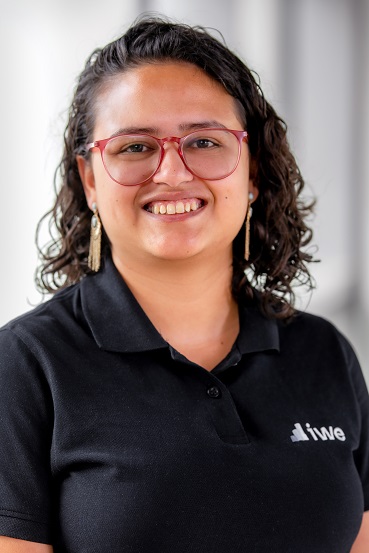
Paola Acosta Carrascal
Research Associate


Projects
More Research Projects

Decision Support System for Sponge-like Corridors
Active
Feasibility study for the development of a decision support system for analyzing the impact of measures for runoff-slowing and water-retaining landscape design
To the Project
Reform of industrial wastewater treatment in Saudi Arabia through demonstration of a3op® technology
Active
To the Project
BIK3I
Active
Condition-based maintenance of small-scale sewage treatment plants using IoT and AI
To the Project


Wasser hoferLand.digital Transfer Workshop
Active
The Water Transfer Workshop connects applied research, digital innovation, and municipal action into a laboratory space
To the Project

ReKorD
Active
Realization of a supra-regional circular economy through fertilizer development
To the Project

DRhN-Booster
Completed
Digital Recruiting for Sustainability – AI-supported educational module
To the Project


TIMEA
Completed
Accelerating the transfer of innovations through web-based multi-level analysis
To the Project
Sponge Balcony
Completed
Sponge Balcony – concept development for innovative evaporation production
To the Project
digi-Sponge (Certificate Course)
Completed
Certificate course on digital methods in sponge city projects
To the Project
Rotary Arc 4.0
Completed
Dynamic sewer network management with obstacle-free control element
To the Project

IntelliFluQs
Completed
Intelligent flow and quality control for the fourth treatment stage
To the Project
ITTQ-Wasser
Completed
Engineering-technical transfer qualification for Bavarian water management
To the Project


pharmIn2
Completed
Efficient treatment of wastewater from the pharmaceutical industry in India
To the Project

InSchuKa4.0
Completed
Combined infrastructure and environmental protection through AI-based sewer network management
To the Project