Digital Primary School Schauenstein
Digital Primary School Schauenstein
Funding Programme
The German Federal Environmental Foundation is funding the joint project
Background
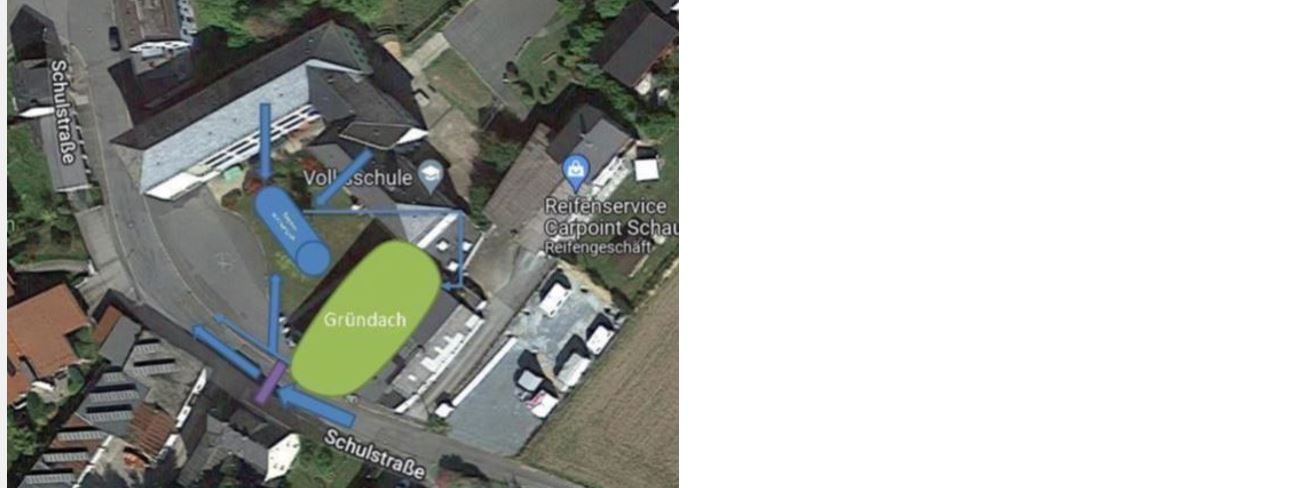
As part of the primary school refurbishment, the town of Schauenstein has installed a green roof on the sports hall to collect rainwater from the building’s roofs in an underground storage tank. The focus is on analysing extreme weather events – such as heavy rainfall and dry spells – as key variable and locally occurring effects of climate change, as well as the importance of digitalisation as a solution for better managing, preventing or mitigating these negative impacts. The town has contacted the University of Applied Sciences in Hof to take part in the SPORE research project. SPORE investigates the effects of climate change in the Upper Franconia region, particularly in relation to heavy rainfall and dry spells. Schauenstein Primary School was selected as a suitable project to investigate the impact of extreme weather events on buildings. A digital rain and water management system is being developed to enable pupils to experience the effects of climate change first-hand in the classroom.
Source: https://www.purple-roof.com/
Objectives
The DiGrus project aims, for the first time, to monitor the green roof of the primary school in Schauenstein itself – and its impact on the school’s rainwater and water management – using digital technology, whilst also enabling primary school pupils to learn about and experience it first-hand. Various teaching concepts relating to climate change, weather phenomena and sustainability are to be developed both theoretically and practically, and presented in a way that is suitable for primary school pupils. Using a digital twin, the rainwater and water management system of the new green roof is to replicate the school’s ‘sponge’ concept. In this way, elements of gamification, amongst other things, can be used to playfully test and discover the effects of various alternative courses of action in dealing with climate-induced extreme weather events, both individually and in groups. At the same time, what has been learnt virtually can be observed in reality, experienced through the senses and reflected upon under the guidance of teaching staff. The flexibility of the system also allows for the development and testing of new teaching and learning methods, such as those designed to support self-regulatory skills for the development of early academic competences, which are important for sustainable behaviour based on facts rather than emotion-based information.
Contents
Procedure
- Start: 1 January 24
- Duration: 1.5 years
- First phase:
- Development and implementation of the forward-looking rainwater management system
- Development of teaching concepts by teachers at Schauenstein Primary School and Hof University of Applied Sciences
- Second phase:
- Integration of the real-world system into the curriculum
Target group: Year 3 and 4 school classes
Technology
A wide range of technologies is represented in this project. A high degree of interdisciplinary work is required to bring the project to fruition. Here is an overview of the key areas of technology:
- IoT
- Fluid mechanics
- Weather/climate/rain simulations
- Various sensors (temperature, humidity, etc.)
- Pumps & valves (remotely controllable)
- SCADA
- Digital twin
- AR/VR
- Databases
A major challenge in software development is bringing all these subsystems together. To achieve this, particular attention must be paid to the interfaces between the subsystems.
Project Partners
Town of Schauenstein; University of Münster

Addressed SDGs (Sustainable Development Goals)
Contact Persons
Prof. Günter Müller-Czygan
Head of Research Group



Robert-Peter Kuhn
Research Associate
Projects
More Research Projects

Decision Support System for Sponge-like Corridors
Active
Feasibility study for the development of a decision support system for analyzing the impact of measures for runoff-slowing and water-retaining landscape design
To the Project
Reform of industrial wastewater treatment in Saudi Arabia through demonstration of a3op® technology
Active
To the Project
BIK3I
Active
Condition-based maintenance of small-scale sewage treatment plants using IoT and AI
To the Project

Wasser hoferLand.digital Transfer Workshop
Active
The Water Transfer Workshop connects applied research, digital innovation, and municipal action into a laboratory space
To the Project

ReKorD
Active
Realization of a supra-regional circular economy through fertilizer development
To the Project

DRhN-Booster
Completed
Digital Recruiting for Sustainability – AI-supported educational module
To the Project


TIMEA
Completed
Accelerating the transfer of innovations through web-based multi-level analysis
To the Project
Sponge Balcony
Completed
Sponge Balcony – concept development for innovative evaporation production
To the Project
digi-Sponge (Certificate Course)
Completed
Certificate course on digital methods in sponge city projects
To the Project
Rotary Arc 4.0
Completed
Dynamic sewer network management with obstacle-free control element
To the Project

IntelliFluQs
Completed
Intelligent flow and quality control for the fourth treatment stage
To the Project
ITTQ-Wasser
Completed
Engineering-technical transfer qualification for Bavarian water management
To the Project


pharmIn2
Completed
Efficient treatment of wastewater from the pharmaceutical industry in India
To the Project

InSchuKa4.0
Completed
Combined infrastructure and environmental protection through AI-based sewer network management
To the Project