NIQKI
Precipitation data quality control with artificial intelligence
© HST
Funding Programme
Förderprogramm Bundesministerium für Digitales und Verkehr | mFUND - Das Startkapital für die Mobilität der Zukunft
Background
The comprehensive, high-resolution acquisition of highly valid meteorological data is a crucial prerequisite for reliable precipitation forecasts and the processes based on them. Currently, such data are not available in many regions (e.g., North Rhine-Westphalia) with the required quality and timeliness. Ensuring the prompt availability of valid data for hazard mitigation and similar purposes requires automated validation processes that are transferable and applicable across a wide range of systems.
Objectives
The aim of the project is to develop procedures for verifying the plausibility of precipitation data by incorporating additional climate data and utilizing artificial intelligence (AI) methods for these applications. For the first time, this project employs high-density, widely available spatial data, using a specific federal state as a case study. Improvements to the procedures, user processes, and user acceptance will be analyzed and supported throughout the project.
Contents
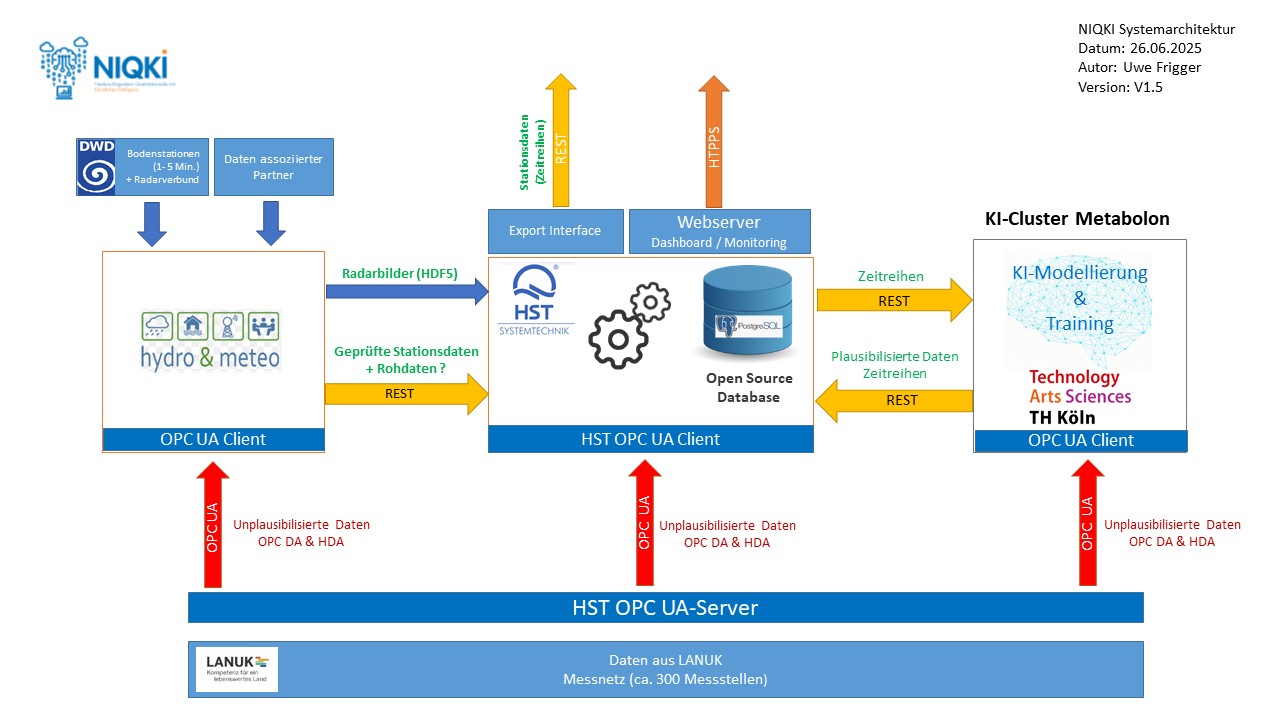
The project aims to develop methods for validating precipitation data using artificial intelligence to improve meteorological forecasts and associated processes. Collected meteorological data are transmitted to the cloud and automatically checked for plausibility within one minute, enabling their use in near real-time. The developed procedures and validated data are made available to LANUV (State Agency for Nature, Environment and Consumer Protection) and integrated into products from HST and hydro & meteo GmbH to enhance climate and flood forecasting.
Implementation
Data collected by LANUV are transferred to the cloud, immediately validated (within < 1 minute), and fed into a wide range of applications for optimal use in near real-time. The AI models are developed and trained using historical data and existing validation expertise (manual checks, semi-automated checks in NIKLAS), and the results are compared with those of previous methodologies.
Further information here: https://fue-hydromet.de/niqki/
Project Partners
Technische Hochschule Köln; LANUV NRW; hydro & meteo GmbH; HST Systemtechnik GmbH

Addressed SDGs (Sustainable Development Goals)
Contact Persons
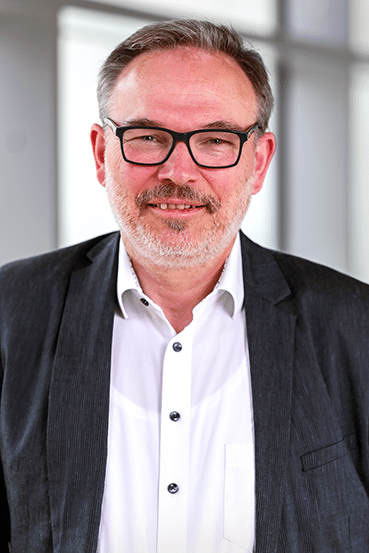
Prof. Günter Müller-Czygan
Head of Research Group


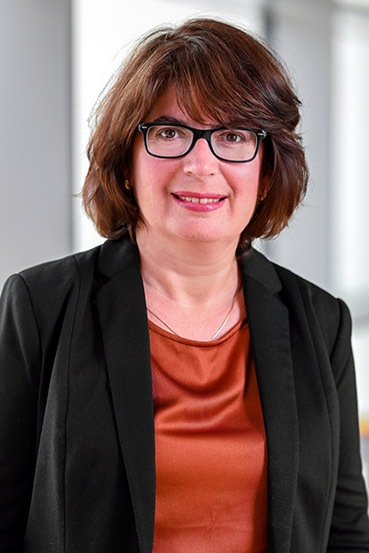
Dr. Viktoriya Tarasyuk
Research Associate
Projects
More Research Projects

Decision Support System for Sponge-like Corridors
Active
Feasibility study for the development of a decision support system for analyzing the impact of measures for runoff-slowing and water-retaining landscape design
To the Project
Reform of industrial wastewater treatment in Saudi Arabia through demonstration of a3op® technology
Active
To the Project
BIK3I
Active
Condition-based maintenance of small-scale sewage treatment plants using IoT and AI
To the Project


Wasser hoferLand.digital Transfer Workshop
Active
The Water Transfer Workshop connects applied research, digital innovation, and municipal action into a laboratory space
To the Project

ReKorD
Active
Realization of a supra-regional circular economy through fertilizer development
To the Project


DRhN-Booster
Completed
Digital Recruiting for Sustainability – AI-supported educational module
To the Project


TIMEA
Completed
Accelerating the transfer of innovations through web-based multi-level analysis
To the Project
Sponge Balcony
Completed
Sponge Balcony – concept development for innovative evaporation production
To the Project
digi-Sponge (Certificate Course)
Completed
Certificate course on digital methods in sponge city projects
To the Project
Rotary Arc 4.0
Completed
Dynamic sewer network management with obstacle-free control element
To the Project

IntelliFluQs
Completed
Intelligent flow and quality control for the fourth treatment stage
To the Project
ITTQ-Wasser
Completed
Engineering-technical transfer qualification for Bavarian water management
To the Project

pharmIn2
Completed
Efficient treatment of wastewater from the pharmaceutical industry in India
To the Project

InSchuKa4.0
Completed
Combined infrastructure and environmental protection through AI-based sewer network management
To the Project