
EULe
Electrochemical post-treatment of biologically produced urine fertilizer
Funding Programme
Background
Given the finite nature of fossil resources and the challenges associated with centralized wastewater treatment, decentralized nutrient recovery is gaining importance. A key focus is the efficient removal of micropollutants, such as those found in hospital urine.
Planned Activities
The project involves testing the development and integration of demonstration units for post-treatment using diamond electrolysis and photocatalysis. Measurement campaigns will evaluate the nitrogen balance, pathogen elimination, removal of trace substances, and operational efficiency. Plans are in place to scale up the technology for commercial applications.
The project aims to provide sustainable, energy-efficient alternatives to existing processes and to promote nutrient reuse.
Objectives
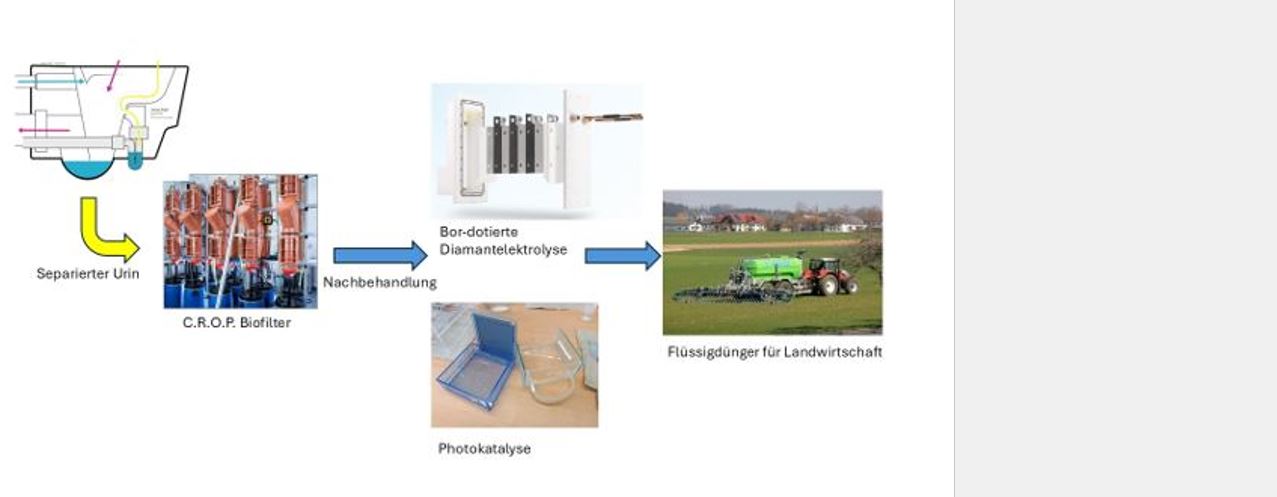
The project aims to simplify the processing of separately collected human urine into a safe, high-quality fertilizer. This is to be achieved through a biological filtration process (C.R.O.P.®), followed by the removal of pathogens and organic micropollutants using physicochemical methods such as diamond electrolysis or photocatalytic oxidation. The method is designed to operate without consumables that generate waste, require minimal maintenance, and offer versatile application.
Contents
The project is developing a process to treat human urine and convert it into a safe, high-quality fertilizer. The focus is on using a biological filtration method (C.R.O.P.®) to nitrify the urine. Subsequently, pathogens and micropollutants—such as pharmaceutical residues—are removed using physicochemical processes like diamond electrolysis and photocatalytic oxidation. The goal is to create an environmentally friendly method that requires no consumables or chemicals.
The technology being developed is designed to be energy-efficient, low-maintenance, and versatile—suitable, for example, for treating urine from hospitals or for use in greenhouse systems. In doing so, the project addresses the challenges associated with centralized wastewater systems, which are characterized by inflexibility and high energy consumption. It responds to the finite nature of raw materials like phosphate and the growing concern regarding micropollutants in wastewater.
Demonstrators for the post-treatment processes are being developed and tested in conjunction with the C.R.O.P.® filters. Comprehensive measurements are being conducted to evaluate the nitrogen balance, pathogen elimination, and pollutant removal. The technology is also being assessed for scalability and practical applicability.
The project contributes to decentralized nutrient recovery and a sustainable circular economy. It promises energy and resource savings compared to conventional methods while ensuring compliance with high environmental and hygiene standards.
Project Partners
DLR; Synantik GmbH; Diaccon GmbH; Finizio GmbH; Goldeimer gGmbH
DLR Deutsches Zentrum für Luft- und Raumfahrt e.V.
Institut für Luft- und Raumfahrtmedizin Gravitationsbiologie Linder Höhe 51147 Köln
More →


Addressed SDGs (Sustainable Development Goals)
Contact Persons
Prof. Dr.-Ing. Tobias Schnabel
Head of Research Group


Axel Wolfram
Research Associate
Projects
More Research Projects

Decision Support System for Sponge-like Corridors
Active
Feasibility study for the development of a decision support system for analyzing the impact of measures for runoff-slowing and water-retaining landscape design
To the Project
Reform of industrial wastewater treatment in Saudi Arabia through demonstration of a3op® technology
Active
To the Project
BIK3I
Active
Condition-based maintenance of small-scale sewage treatment plants using IoT and AI
To the Project



Wasser hoferLand.digital Transfer Workshop
Active
The Water Transfer Workshop connects applied research, digital innovation, and municipal action into a laboratory space
To the Project

ReKorD
Active
Realization of a supra-regional circular economy through fertilizer development
To the Project


DRhN-Booster
Completed
Digital Recruiting for Sustainability – AI-supported educational module
To the Project

TIMEA
Completed
Accelerating the transfer of innovations through web-based multi-level analysis
To the Project
Sponge Balcony
Completed
Sponge Balcony – concept development for innovative evaporation production
To the Project
digi-Sponge (Certificate Course)
Completed
Certificate course on digital methods in sponge city projects
To the Project
Rotary Arc 4.0
Completed
Dynamic sewer network management with obstacle-free control element
To the Project


IntelliFluQs
Completed
Intelligent flow and quality control for the fourth treatment stage
To the Project
ITTQ-Wasser
Completed
Engineering-technical transfer qualification for Bavarian water management
To the Project



pharmIn2
Completed
Efficient treatment of wastewater from the pharmaceutical industry in India
To the Project

InSchuKa4.0
Completed
Combined infrastructure and environmental protection through AI-based sewer network management
To the Project